

Are you frustrated by unwanted hair growth in unusual places such as on the face, neck, chest, and back? You’ve been shaving, plucking, threading, waxing, even tried laser, but you’re still reaching for your tweezers? You’re not alone.
Because we see and treat unwanted hair growth daily, we share expert advice on electrolysis: the only permanent hair removal method. We’d like to help you make informed decisions and achieve long-lasting results and smooth, hair free skin.
Electrolysis science and success
Of all the methods of hair removal that are considered permanent, electrolysis still stands alone as the only FDA approved method for permanent hair removal. Laser treatments are classified as permanent hair reduction which means that there will always be some hairs left after treatment.
No other hair removal solution can claim the universal acceptability and success offered by electrolysis. Electrolysis safely and permanently removes all colours and types of hair from all skin tones. Electrolysis permanently destroys the growth cells of the hair follicle, preventing treated hairs in their active growth phase from ever growing back. Treatment can be applied to most facial and body parts including chin, jaw line, sides of the face, eyebrows, upper and lower lip, breasts, underarms, abdomen, fingers and toes, legs and back.
How it works
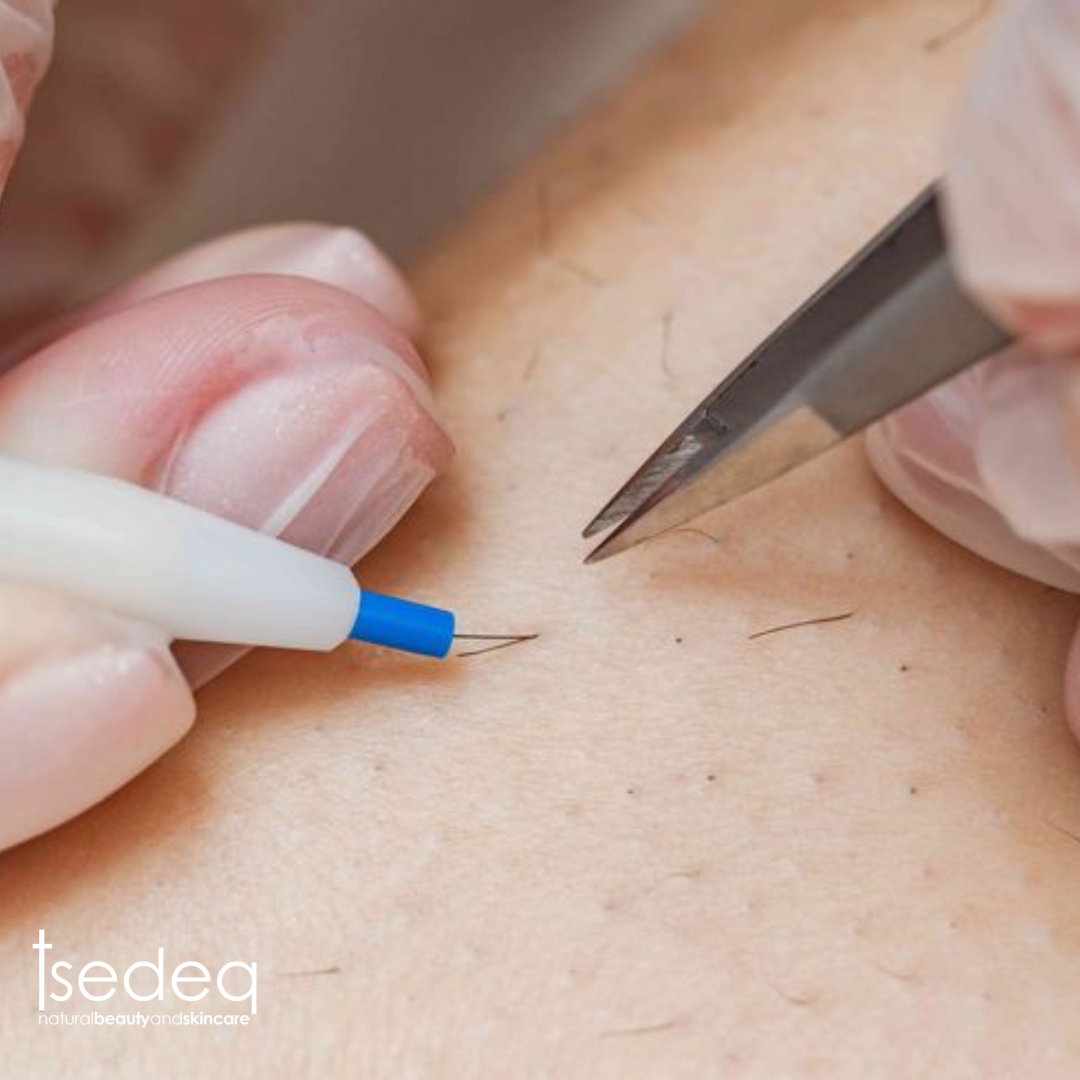
Electrolysis is designed to fully eliminate the hair’s growth capacity rather than weaken it temporarily. A very fine disposable, sterile probe is inserted into each individual hair follicle. The insertion is virtually painless. When the probe reaches the end of the follicle where the hair root meets the dermal papilla (blood source to the hair follicle), a mild electrical current is emitted, effectively destroying the hair growth cells. Without its blood source, the follicle dies. The hair is then removed from the follicle.
Electrolysis and laser: know the difference
- Both electrolysis and laser working mechanisms are targeting hair follicles located under the skin’s surface.
- Electrolysis treats each hair follicle individually; lasers are designed to treat larger areas.
- Electrolysis can safely treat any colour hair, on any colour skin (including melanin rich skins). Lasers are not effective treating light, red, grey hair or melanin rich skins safely. In fact, there can be an increase of hair (mild hypertrichosis) due to exposure to laser treatment.
- Electrolysis is considered best for removing hair from smaller areas like the face, bikini line, or where they are not so dense.
- Electrolysis is extremely versatile and may be used anywhere on the body, even the sensitive areas around the eyes, ears, eye lids, etc.
Causes of unwanted hair growth
In general, hair growth is the result of heredity and hormone levels. Some pharmaceutical drugs, temporary methods of hair removal, and illnesses can also contribute to excessive stimulation of hair growth.
Hirsutism (excessive hair growth) in women
Hirsutism is medical condition of excessive hair growth where the hair growth changes from vellus (peach fuzz) to terminal hair (stronger, harder, courser hair). Hirsutism occurs because of an increased production of male hormones (androgens). Hirsutism can be treated by medical intervention, but the hairs that resulted from the hormonal changes can be addressed by method of electrolysis.
Androgens & facial hair – vellus hair and terminal hair
- Vellus hair (peach fuzz) is usually light, fine and short. Found on face, arms, back, etc.
- Terminal hair is coarse, thick, long and usually found at genitals, scalp and under arms.
Among the many symptoms of PCOS is HIRSUTISM and affects 70% of women suffering from PCOS. In the case of individuals with PCOS, hair follicles become sensitive to hormones. Higher levels of androgens cause the vellus hair to convert into terminal hair, resulting in thicker, darker and larger hair. Areas most affective by this include chin, neck, upper lip, breast, lower abdomen, inner thighs and lower back.
Women living with PCOS generally experience hair growth that is two to three times faster and thicker than usual. Their hair can grow up to 1mm in one day.
These factors may also influence female hair growth changes / Hirsutism
- Obesity
- Medication
- Heredity / genetics
- Adrenal gland disorders
- Severe insulin resistance
- Polycystic ovary syndrome
- Changes in hormones from menopause
- Cushing’s syndrome and Cushing’s disease
- Use of anabolic steroids or corticosteroids
- Disorders of the pituitary gland, adrenal gland, or thyroid gland
- Certain medications including birth control pills, hormones and anabolic steroids
- In some cases, the cause isn’t known (Idiopathic hirsutism)
How many electrolysis treatments will I need?
The number of treatments required will vary from one individual to the next, the cause of the hair growth, the growth cycle, the area and density of the hair that are being treated and the tolerance of each individual.
Results aren’t achieved in just one session. This is especially true when the procedure is done on large areas, when thicker or hormone induced hair growth is being treated. It will require a considerable amount of patience on your part to achieve success. Hairs that are treated in the early growth (anagen) stage, will produce the best outcome.
Weekly or bi-weekly treatment sessions will be needed to achieve optimal results. The entire treatment generally spans 8-12 months with individual treatments every two to three weeks. The number of treatments could be anywhere between 12-20. Once treating the areas of concern are completed, there is no reason for follow up treatments, unless new growth because of hormonal changes may be experienced.
Can I have electrolysis if I’m pregnant?
No, pregnancy is a contra-indication to electrolysis, simply because there aren’t any safety studies on the subject. We suggest you enjoy your pregnancy and address the unwanted hairs afterwards when your hormone levels have returned to normal.
How long does each electrolysis treatment take?
The time required for removing hair varies and is dictated by the client’s sensitivity, area being treated, size of the area, hair density and thickness, current stage / growth cycle, previous hair removal methods as well as the responsiveness of client’s skin to the treatment. An average treatment ranges between 15 – 60 minutes. Your individual needs & treatment will be discussed with you a consultation.
What the skin looks like after treatment
Some tenderness, redness and mild localized swelling immediately following electrolysis is completely normal. Special aftercare will be applied in clinic. Small whiteheads, tiny scabs & dryness may occur. Some clients may see tiny reddish brown pinprick scabs. If scabbing does occur, it is of the utmost importance to not pick or scratch as these will heal and disappear naturally within a few days. It is important to remember that scabs are a part of the normal healing process in some individuals.
Aftercare
At Tsedeq naturalbeautyandskincare, our primary focus will always be on our client’s skin and aesthetic healing. We prioritize the skin that was treated with electrolysis and therefore specific aftercare will be prescribed and discussed with you to help your skin recover and renew.
Scratching, picking at the microscopic scabs that may form after treatments, improper aftercare or using makeup could lead to undesired outcomes.
Skin discolouration, freckling or hyperpigmentation may occur, especially if the case of hormonally induced hair growth. Certain specific aftercare products containing melanin inhibiting functions may be prescribed to help prevent any discolouration. Being diligent and using the correct prescribed aftercare will help facilitate aesthetic healing and help prevent hyperpigmentation, freckling, etc.
Between treatments While committing to electrolysis, make sure you fight the urge to pluck or tweeze in between treatments. Plucking or tweezing between electrolysis appointments will inevitably reduce the number of hairs your electrologist can remove during your session. You are, however allowed to shave the area in between treatments.
Should you have any other questions, please do not hesistate to message here: https://tsedeq.co.za/contact/
